
India's manufacturing sector growth moderated in August as output and sales rose at slowest rates since January, while competitive pressures and inflation concerns hampered business confidence, a monthly survey said on Monday. The seasonally adjusted HSBC India Manufacturing Purchasing Managers' Index (PMI) stood at 57.5 in August, below July's reading of 58.1 but above its long-run average of 54.0, signalling a substantial improvement in operating conditions.

Given the stronger rural activity, and potential goods and services tax (GST) impact, investors are bullish on the two-wheeler (2W) segment. In August, dealers in the domestic market picked up 11 per cent more 2Ws year-on-year (Y-o-Y), despite only 2 per cent growth in retail registrations. This indicates inventory stocking ahead of the festival season. Export trends were good. TVS Motor and Royal Enfield may have gained domestic market share.

Digipin promises to revolutionise location-based services in India with safeguards.

ICICI Bank was the top loser in the Sensex pack, shedding around 2 per cent, followed by Bharti Airtel, Axis Bank, Kotak Bank and PowerGrid. NSE Nifty closed 7.55 points or 0.07 per cent down at 11,527.45.

With factory production, activities across the private sector saw the biggest drop in over three years

New business orders fall at faster pace, with index at 47.6 in March from 49.5 in February.

Manufacturing production growth eased in May, which combined with the slowdown in services resulted in a weaker increase in private sector output, the survey said.

Despite fears of the Omicron variant, business activity touched an all-time high since the onset of the pandemic for the week ended December 12, a Japanese brokerage said on Monday. The Nomura India Business Resumption Index (NIBRI), which compares the activity for a particular week as against the one before the onset of the pandemic, rose to 115.8 from the 112.9 for the previous week. "Despite Omicron risks, neither policy restrictions nor public fear factor appear to have had any impact on mobility so far, which is supporting a further normalisation in services," it said in a statement.

Hiring trends in India's white-collar job market dipped marginally by 1.4 per cent in March compared to the same month last year, driven by a decline in recruitment in the retail, oil & gas, and education sectors, a report said on Wednesday.
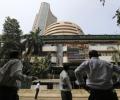
Top gainers in the Sensex pack included IndusInd Bank, ITC, L&T, M&M, PowerGrid, Asian Paints and SBI, ending up to 3.79 per cent higher.

A multibagger stock multiplies its original investment several times, delivering returns of 100%, 200%, or even higher. The excitement of finding such wealth creators is undeniable, but the process of identifying them is far from simple. It requires a careful blend of research, patience, and the right set of tools.

Equity benchmark indices ended flat on Wednesday with Sensex sliding 33 points and Nifty gaining 9 points after an unabated record-breaking rally in the last few trading sessions. Weak global market trends and fall in HDFC twins also spoiled markets party. The 30-share BSE Sensex dipped 33.01 points or 0.05 per cent to settle at 65,446.04.

Hiring activity witnessed a 6 per cent year-on-year growth in March this year, supported by a rebound in economic activities and led by sectors such as banking and telecom, according to a report. However, there was a marginal dip of 2.4 per cent in hiring activity as compared to February, owing to the appraisal season, according to the Monster Employment Index (MEI). "Two years into the pandemic, it is heartening to see that the Indian economy has overcome setbacks and challenges with hiring momentum exceeding pre-COVID levels by 6 per cent this year compared to 2020," Monster.com, a Quess company, CEO Sekhar Garisa noted.

The HSBC/Markit purchasing managers index for the services industry inched up to 47.1 in October from 44.6 in September, the fourth successive monthly contraction of service sector output across India.

A day after his appointment as the 26th governor of the Reserve Bank of India (RBI), outgoing Revenue Secretary Sanjay Malhotra on Tuesday said one must understand the economic landscape and do what was best for the economy. "Let me first go, join, understand the turf ... Here it is a different role," Malhotra said, speaking to reporters in front of North Block.


The last time these two indexes recorded a negative performance on a calendar year basis was in CY19.

Geopolitical developments between India and Pakistan, quarterly earnings and macro data will be the key drivers of stock markets in the holiday-shortened week, say analysts.

The 50-issue NSE Nifty too cracked below the 10,400-mark and hit a low of 10,323.90 before finishing 99.50 points, or 0.95 per cent down at 10,358.85.
Manufacturing activities in India advanced further and touched a 31-month high in May supported by stronger increase in new orders and favourable market conditions, which in turn generated more employment opportunities, a monthly survey said on Thursday. The seasonally adjusted S&P Global India Manufacturing Purchasing Managers' Index (PMI) rose from 57.2 in April to 58.7 in May, indicating the strongest improvement in the health of the sector since October 2020. The May PMI data pointed to an improvement in overall operating conditions for the 23rd straight month.

On the employment front, services employment was unchanged in April.

Ask rediffGURU and PF expert Nitin Narkhede your mutual fund and personal finance-related questions.

The HSBC Emerging Markets Index, a monthly indicator derived from the PMI surveys, inched up to 50.4 in April, from 50.3 in March, signalling only a marginal increase in output across global emerging markets in April.

India's services industry expanded at its fastest pace in eight months in October as new business rose with discounting probably stoking demand, a survey showed on Wednesday.

The improvement in the performance of actively managed mutual fund (MF) schemes is acting as a key tailwind for the nearly Rs 50 trillion industry, Kotak Institutional Equities (KIE) said in a report. The report adds that the two largest listed asset management companies (AMCs) - HDFC and Nippon India - are likely to be the biggest beneficiaries. "The industry has a solid track record of delivering alpha on 10-year returns (70-80 per cent of assets under management (AUM) beat the benchmark), with shorter duration performance also on an upswing.
Manufacturing activities in India accelerated further and touched a four-month high in April, boosted by robust new business growth, mild price pressures, better international sales, and improving supply-chain conditions, a monthly survey said on Monday. The seasonally adjusted S&P Global India Manufacturing Purchasing Managers' Index (PMI) increased from 56.4 in March to 57.2 in April, indicating the fastest improvement in the health of the sector so far this year. The March PMI data pointed to an improvement in overall operating conditions for the 22nd straight month.

Meanwhile, outlook for global emerging markets remained relatively weak in September.

Days before Diwali, the monthly economic review by the finance ministry has highlighted moderation in urban demand, softening consumer sentiments and limited footfall as areas that need to be watched. In its review, released on Monday, the ministry also noted the early signs of artificial intelligence displacing workers, as described in anecdotal reports. The commentary from several large consumer goods companies, including Nestl India, Hindustan Unilever, and ITC, in their recent quarterly earnings, has been around a sluggish urban demand. Rural consumption, however, has mostly seen a revival, the companies pointed out.

Even as concerns grow over the residential real estate market reaching its peak, the outlook for office real estate remains strong, with listed real estate investment trusts (Reits) standing to benefit from sustained demand in the segment.
While manufacturing firms cut jobs for the first time in 20 months to sharply reduce costs, services providers continued their hiring spree.

Equity benchmarks started the first day of trade of the New Year on a positive note and ended with smart gains, propelled by buying in index majors Reliance Industries and ICICI Bank amid a firm trend in European markets. The 30-share BSE Sensex climbed 327.05 points or 0.54 per cent to settle at 61,167.79 on Monday. During the day, it jumped 382.05 points or 0.62 per cent to 61,222.79.

Currency scarcity weighed on manufacturing performance where growth of new work flows slowed

Private sector output in India expanded for the first time in 8 months in February as slump in the services sector moderated and manufacturing grew at a stronger pace, an HSBC survey said.

The index has posted below the 50 mark, which marks contraction, for the third consecutive month.

The HSBC/Markit Purchasing Managers Index for the services industry fell to 46.7 in December from 47.2 in November, registering the sixth consecutive monthly drop in output levels, the longest period of continuous reduction since the 2008/2009 global financial crisis.

Hiring activity in the country, which was hit by the second COVID wave, bounced back with a 15 per cent growth in June compared to May, according to a report. The activity was led by the IT-software/software services sector. The latest Naukri JobSpeak report on Thursday said that India's hiring trends grew 15 per cent in June with 2,359 job postings from 2,047 in May.

While Jio MF will undoubtedly grow in size, it will have to cross multiple hurdles even to emerge as the market leader, observes Debashis Basu.

It was the second straight week of gains for the benchmarks.

The broader NSE Nifty rose nearly 124 points to settle just below the psychological 11,000 level.

The Nikkei India Services PMI posted above the critical 50.0 level, which separates growth from contraction, for the fourth month running in May.
 © 2026 Rediff.com - Advertise with us - Disclaimer - Privacy Policy - Sitemap - Feedback - About us - Terms of use - Grievances